
DENTAL PRACTICE VALUATIONS
Independent dental practice valuations for Australian dentists and dental groups
A dental practice is valued on the profit it can sustain after every dentist, including the principal, is paid a market rate for the dentistry they produce. That maintainable profit is converted to value using a multiple reflecting how much of the patient base, fee income and clinical capacity would survive a change of owner. Dental is distinctive: almost all revenue is private, equipment is costly to renew and the principal often produces a large share of fees.
- General dental practices
- Specialist dental practices
- Orthodontic practices
- Multi-chair dental clinics
- Dental groups and multi-site operators
- Dental prosthetist practices
- Practices in health fund and corporate networks
Published
Updated
What is a dental practice valuation?
A dental practice valuation is an independent opinion of what a dental business is worth at a stated valuation date (the date at which value is assessed, on information known or reasonably foreseeable then) and for a stated purpose. It may value the business as a going concern, the goodwill, equipment and stock that change hands in a practice sale, or the shares in the owning entity.
Most engagements are expressed as market value: the price a knowledgeable, willing but not anxious buyer and seller would agree at arm's length. A price is different, because it reflects one buyer's circumstances and the deal terms, which is why an offer and a valuation can differ without either being wrong.
The core of the exercise is maintainable earnings: the profit the practice can sustain after paying every clinician, including the owner, a market rate for the dentistry they perform. That adjustment often moves the answer more than any other, because the principal frequently produces a large share of gross fees and takes profit rather than a wage.
Dental funding also sits apart from the rest of healthcare. The Australian Institute of Health and Welfare (AIHW) reports that $13.2 billion was spent on dental services in 2023-24, that individuals directly funded 61 per cent of it and that health insurance funds contributed $2.6 billion. There is no general Medicare rebate for routine adult dental care, so a dental practice is largely a private-fee business. See our valuation services and How to Value a Dental Practice.
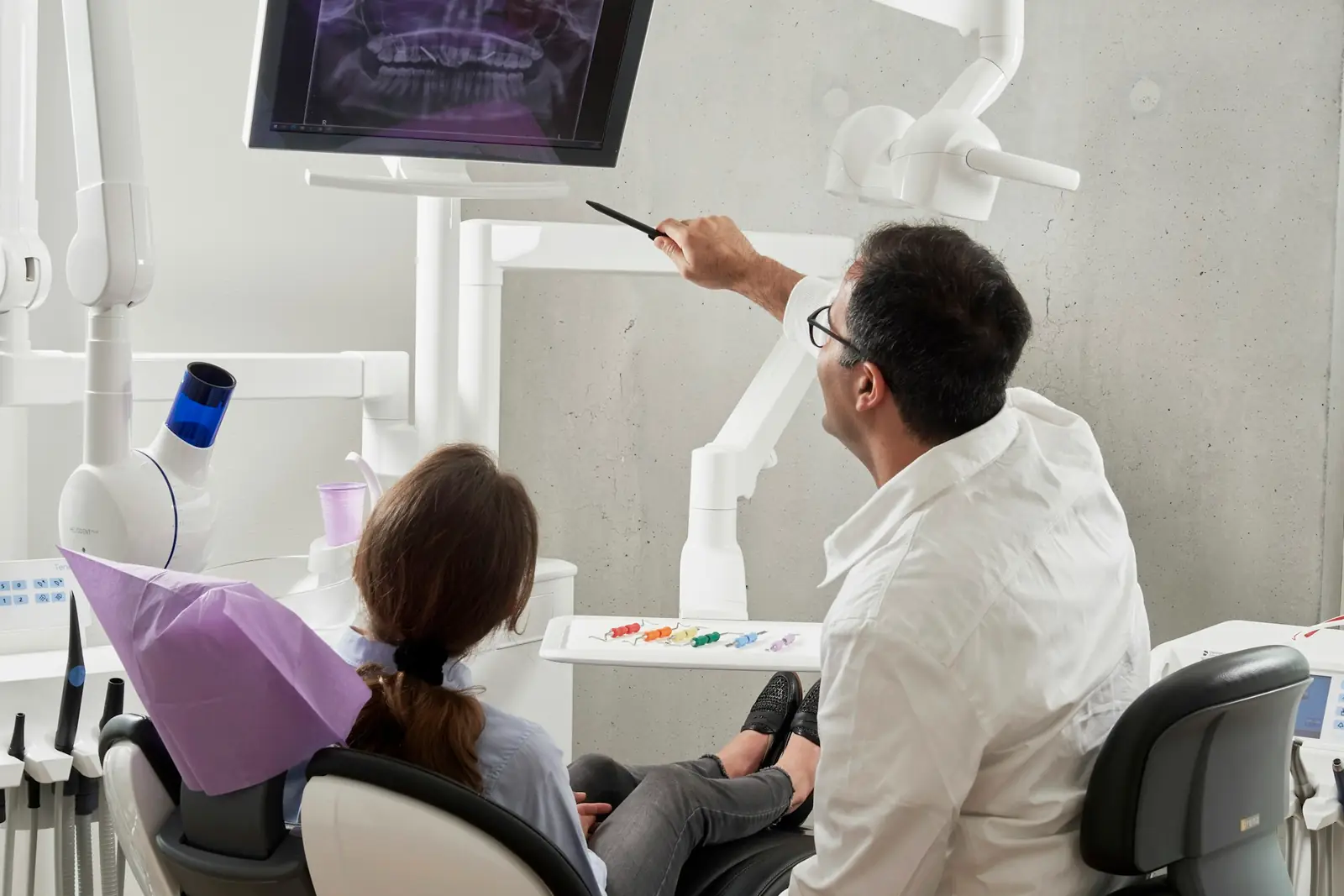
When a dental practice valuation may be required
Dental practices change hands, admit partners and restructure often, and each event turns on a defensible value.
Sale to a dentist or a dental group
Corporate groups buy alongside individual dentists: Bupa Dental reports more than 170 practices, Pacific Smiles Group over 120 dental centres trading as Pacific Smiles Dental, nib Dental and HBF Dental, Maven Dental more than 105 clinics and National Dental Care more than 100. They do not all buy the same thing, and Maven describes itself as a dental support organisation providing facilities to dentists who run independent practices from its clinics, while other buyers acquire the business and engage the clinicians. A valuation tests what is being bought and the retention, earn-out and restraint conditions attached. See sale and exit valuations.
Associate buy-in or partner admission
The price should separate goodwill attributable to the incoming associate's own patients from the practice's goodwill, and set the buy-in on a share of equity value (the owners' interest after debt), not turnover.
Principal exit and succession
The valuation models how much of the principal's production and patient loyalty is likely to transfer under a transition and a restraint. See succession planning valuations.
Specialist practice referral changes
Orthodontic, periodontal, endodontic and oral surgery practices depend on referrals from general dentists, so value shifts when a major referrer retires or joins a group with its own specialists.
Family law property settlements
Family law matter? See our dedicated family law practice, Family Law Valuations.
Tax and restructure events
A move into a company or trust, a new service entity or a capital gains tax question calls for a market value at a date that will withstand scrutiny. See tax and restructure valuations.
Shareholder exits and disputes in dental groups
A parcel of shares in a group is valued as a minority interest (a holding that cannot control the company) where appropriate, with a reasoned decision on any discount for lack of control. See share and equity valuations.
How dental practices are valued
In this section
Start with what the practice produces
Dental fees are billed item by item, so production can be analysed by provider, item group and payer. We examine gross fees by clinician, fees per chair hour, chair utilisation, active patients (defined in the report, for example patients seen in the previous 24 months), recall compliance and new patients per month. That is the evidence for goodwill: the amount the practice is worth beyond its identifiable assets net of liabilities, built on patients who return and patients who arrive without the owner.
Pay every clinician at market, including the principal
The key dental normalisation (adjusting reported profit to what a new owner would experience) replaces the principal's drawings with the cost of an associate producing the same fees. Where the principal produces most of the fees, maintainable earnings after that adjustment may be modest, and much of what looks like value is personal goodwill (attached to the individual and lost when they leave) rather than transferable goodwill (attached to the location, systems, team, records and brand, and able to pass to a buyer). That is key-person risk in its clearest form.
Leverage is the counterweight: hygienists and oral health therapists deliver preventive and periodontal care without occupying a dentist's chair. Dental Board of Australia registrant data for the quarter ended 31 March 2026 records 29,119 registered dental practitioners, including 21,644 in the dentist division, 3,631 oral health therapists, 1,510 dental hygienists, 1,283 dental prosthetists and 515 dental therapists, and the Australian Institute of Health and Welfare reports that 49.4 per cent of employed dentists worked part time in 2024. Headcount therefore overstates available chair time, and availability limits how quickly a buyer could replace the principal's output. See practitioner dependence.
Payer mix
Most dental fees are private, commonly with a health fund extras rebate claimed at the chairside. The Australian Prudential Regulation Authority reports that dental was the largest component of general treatment benefits in the June 2026 quarter, at $1,001.79 million of the $1,804.16 million insurers paid. The Australian Government's privatehealth.gov.au explains that insurers have arrangements with preferred providers to treat members at a higher benefit rate than a non-preferred provider, and that each insurer runs its own network: Bupa offers members on eligible extras cover 100 per cent back on up to two six-monthly check-ups and cleans a year at its Members First Ultimate practices. The insurer sets those rates, so we record the share of fees earned at agreed rates and the margin on that work after laboratory and clinician costs. Insurers sit on the supply side too, through Bupa Dental and through the centres Pacific Smiles Group operates for nib and HBF.
Government funding is narrow but can be concentrated. Services Australia states that the Child Dental Benefits Schedule (CDBS) covers up to $1,158 for each eligible child across two consecutive calendar years, that the cap is indexed on 1 January, and that orthodontic work, cosmetic work and any dental service in a hospital are excluded. Eligibility turns on Medicare enrolment, being aged 0 to 17 for at least one day in the calendar year, and receipt of a listed payment such as Family Tax Benefit Part A or Parenting Payment. Under the Department of Veterans' Affairs (DVA) fee schedule effective 1 July 2026, Schedule B items including implant prostheses require prior financial authorisation for all Gold and White Card holders, while Schedule C items share a biennial monetary limit under which DVA pays up to $5,980.30 every two years commencing 1 January 2026. Either program brings fee and policy risk the practice cannot influence.
Equipment, fit-out and premises
Dental is capital-intensive in a way most allied health is not. Chairs and dental units, an orthopantomogram (OPG) or cone beam computed tomography (CBCT) unit, digital sensors, intra-oral scanners, CAD/CAM milling equipment and sterilisers wear out on different cycles, and accounting depreciation follows tax effective lives rather than the date a buyer writes the cheque. We build a sustaining capital expenditure allowance from the age and condition of each asset and deduct it from earnings, because a practice trading on ageing chairs is not as profitable as its profit and loss suggests.
Fit-out is largely sunk cost, because plumbed and shielded surgeries do not relocate. The lease term, remaining options, assignment rights and make-good obligations therefore decide whether any of it is recoverable, and a short lease with no options is a common reason a dental goodwill figure is reduced. See premises and lease terms.
Registration and compliance
Every clinician must hold registration with the Dental Board of Australia through Ahpra in one of its five divisions. The Board's March 2026 registrant data records 2,057 registrations across the 13 approved dental specialities, orthodontics the largest at 650. Each division works to an approved scope of practice, and scope has commercial consequences: the DVA schedule states that from 1 January 2026 dental therapists, dental hygienists and oral health therapists may practise independently within their own scope, without a dentist supervising.
Radiation apparatus licensing sits with state and territory regulators and is not uniform. Victoria's Department of Health requires a radiation management licence, issued only to a legal entity and supported by a radiation management plan, before a practice may possess an OPG or CBCT unit, and requires the plan again when that licence transfers to another legal entity. Since 1 December 2025 the New South Wales Environment Protection Authority has exempted registered dental practitioners from holding a radiation user licence for extra-oral apparatus used with intra-oral image receptors, orthopantomogram and lateral cephalometric apparatus, subject to the Code of Practice and Safety Guide for Radiation Protection in Dentistry, but not for cone beam computed tomography. Infection control obligations including steriliser validation records run continuously rather than at inspection.
Associates, payroll tax and superannuation
Associate dentists are commonly paid a percentage of the fees they produce, and how that arrangement is characterised is the largest open tax question in dental valuation. Victoria's Revenue Ruling PTA-041 on relevant contracts and medical centres, issued 11 August 2023, listed by the State Revenue Office as current and applying retrospectively as well as prospectively, applies expressly to dental clinics, and Revenue NSW treats dental clinics as part of the medical services industry for the same purpose. The rulings follow Commissioner of State Revenue (Vic) v The Optical Superstore Pty Ltd [2019] VSCA 197, and in Thomas and Naaz Pty Ltd v Chief Commissioner of State Revenue [2023] NSWCA 40 the New South Wales Court of Appeal refused leave to appeal against tribunal decisions upholding payroll tax assessments on payments to contracted practitioners.
The relief Revenue NSW offers runs through its bulk billing support initiative and is tied to payments to contractor general practitioners meeting bulk billing thresholds, so it does not assist a dental practice, and Revenue NSW records that audits of medical practices recommenced on 4 September 2024. The ATO states that contractors paid mainly for their labour are employees for superannuation guarantee purposes whether or not they hold an ABN, and that the position differs where the contract is with a company, trust or partnership, so the entity behind each associate agreement matters. Section 12(3) of the Superannuation Guarantee (Administration) Act 1992 is the underlying provision. Exemptions may be available and should be confirmed with your accountant or lawyer. A valuation reflects the likely ongoing cost in maintainable earnings and treats prior-period exposure as a contingent liability. See payroll tax and contractor arrangements.
From earnings to value
For most established practices the primary method is capitalisation of future maintainable earnings: normalised earnings, struck before interest and tax and either before depreciation and amortisation (EBITDA) or after them (EBIT), multiplied by a capitalisation multiple. The multiple is the inverse of the capitalisation rate, the return a buyer requires for the risk taken on, so it is not a published constant: it moves with the value drivers set out below.
That produces enterprise value, the value of the operating business to all its funders. Equity value deducts interest-bearing debt, including equipment finance, and adds surplus assets, once a normal level of working capital (the trading assets and liabilities needed to keep running) is confirmed. Dental working capital is light because fees are collected at the chair, but consumables, laboratory work in progress and unearned orthodontic and implant deposits still count.
An asset sale (goodwill, equipment, fit-out and stock) and a sale of shares or units in the owning entity are not interchangeable: a share sale carries the entity's history, including payroll tax and superannuation exposure, and the apportionment of price between goodwill, plant and stock has tax consequences that should be confirmed with your accountant. See maintainable earnings, EBITDA multiples and share and equity valuations.
Dental-specific earnings adjustments
These adjustments most often change a dental practice's maintainable earnings.
Principal clinical output at associate rates
The principal's drawings are replaced with the cost of an associate producing the same fees, plus a market cost for any management role.
Associate contract basis
Percentage contracts differ in whether the split applies before or after laboratory costs, fund discounts and bad debts, so each associate is restated on one basis.
Superannuation and payroll tax on associate payments
Where an associate is paid mainly for their labour, superannuation guarantee and payroll tax may apply; amounts not being paid are added as a cost or shown as a contingent liability.
Health fund agreed-fee discounts
Agreed and no-gap discounts are sometimes netted against fees and sometimes expensed, which distorts revenue and the base on which associates are paid.
Laboratory costs and consumables
Crowns, dentures, implant components and aligners carry laboratory costs that should track the treatment mix, and we confirm who bears them under each associate agreement.
Related-party wages, rent and service fees
Family wages, related-party rent and service company fees are restated at market, and any service entity is consolidated so earnings are counted once.
Depreciation, equipment finance and sustaining capital expenditure
Interest and depreciation on chairs, imaging and CAD/CAM equipment give way to an allowance reflecting the real replacement cycle, not the tax treatment.
Orthodontic and treatment-plan deposits
Instalments received ahead of orthodontic and implant treatment are earned as the work is done, so the unearned balance is a liability a buyer inherits, not surplus cash.
Dental-specific risks
Risk is priced through the capitalisation rate, through the earnings base, or by excluding value that will not transfer.
Clinician dependence and departure
Where the principal produces most fees and holds most patient relationships, transferable goodwill is limited, and weak restraints increase the risk that a departing associate takes patients.
Health fund network exposure
Agreed fees and no-gap obligations are set by the insurer, not negotiated practice by practice, and network status can be withdrawn.
Government program change
The CDBS cap and eligibility rules are set by the Commonwealth and indexed annually, and DVA sets its own schedules, authorisation rules and biennial limit.
Radiation and infection control compliance
Missing radiation licences, gaps in steriliser validation records or an open Ahpra notification can reduce the price or delay settlement.
Retrospective payroll tax and superannuation assessments
Associate arrangements can be reassessed for earlier periods, creating a liability that reaches back and also changes the go-forward cost base.
Clinician recruitment and local workforce supply
Replacing the principal's production depends on associates, hygienists and oral health therapists being available locally. Where they are not, a buyer cannot execute the plan the earnings assume.
Lease expiry and relocation
Plumbed and shielded surgeries cannot be moved cheaply, so a short remaining term, no options or a landlord who can refuse assignment puts the goodwill at risk, not just the fit-out.
Value drivers
What drives the value of a dental practice
Buyers and financiers of dental practices pay for the following.
Production spread across clinicians
Fees produced by associates, hygienists and oral health therapists rather than the principal are the clearest evidence that earnings survive a change of owner.
Active patient base and recall
A documented active base with strong recall compliance is the recurring revenue of a dental practice, measured from practice management system data rather than a count of old files.
New patient flow and its source
Steady new patients from word of mouth, location and online presence are worth more than flow that depends on one fund directory or a paid campaign.
Treatment mix and in-house capability
Implants, orthodontics, aligners and cosmetic work kept in-house lift fees per patient, provided the clinicians who perform them are staying.
Chairs, premises and room to grow
Spare chair capacity under a secure lease with options and assignment rights is growth a buyer can execute without relocating.
Modern equipment and digital workflow
Current chairs, digital radiography, intra-oral scanning, CBCT where clinically justified and CAD/CAM cut the capital a buyer must budget early.
Systems, records and transition arrangements
Complete records, documented agreements and a principal who works through a transition under a restraint make goodwill transferable. See transferable goodwill.
Valuation methodologies for dental practices
One primary method is usually supported by a second as a cross-check.
Capitalisation of future maintainable earnings
When used: Established practices with production across more than one clinician.
Normalised EBITDA or EBIT is capitalised at a multiple reflecting the practice's risk. The inputs that usually decide the answer are the cost of replacing the principal's production and the sustaining capital expenditure allowance.
Discounted cash flow
When used: Groups, practices adding chairs or a second site, and practices whose clinician roster is about to change.
Forecast cash flows, including equipment replacement and recruitment, are discounted to a present value, site by site in a group so head office allocations do not mask a weak practice. It is only as reliable as the forecast, so it is paired with a maintainable earnings cross-check.
Net assets
When used: Practices where goodwill is unlikely to transfer, such as a sole practitioner with no transition arrangement.
Chairs, imaging, sterilisation equipment, fit-out and stock are valued at market value or depreciated replacement cost, less liabilities, which makes the personal versus transferable goodwill question explicit rather than hiding it in a multiple.
Market evidence
When used: A cross-check in every engagement, and a closer reference where a comparable sale is near in time and profile.
Reported prices are analysed before they are relied on, because group acquisitions often include earn-outs, retention conditions and restraint payments. A price paid by one buyer on particular terms is evidence of value, not a substitute for it.
Information required for a dental practice valuation
Most of this already sits in the practice management system and the accountant's files. See what information is needed for a business valuation.
Financial
- Financial statements and tax returns for the practice and any service entity for three financial years, plus year-to-date management accounts
- Ledger detail for wages, associate payments, laboratory costs, rent and equipment finance, with finance and lease schedules
- Payroll tax registrations and any revenue office or ATO correspondence on contractor arrangements
Production and patient data
- Gross fees by provider by month
- Fees by item group and by payer (private, health fund agreed rate, CDBS, DVA)
- Active patient count with the definition used, recall statistics and new patients per month
- Chair count, opening hours and utilisation by surgery
Clinical workforce and contracts
- Ahpra registration division and specialty for each clinician
- Associate, hygienist and oral health therapist agreements, including percentage basis, restraints and notice periods
- The principal's intended role after settlement and any transition or restraint offered
- Health fund preferred provider agreements
Equipment, premises and compliance
- Asset register with age and condition of chairs, units, OPG or CBCT, sterilisers, scanners and CAD/CAM equipment
- Lease, options, assignment rights and make-good provisions
- Radiation apparatus registrations, user licences, equipment compliance reports and steriliser validation records
Legal and ownership
- Entity structure, shareholder or unitholder agreements and partnership deeds
- Any offers received, prior valuations or broker appraisals
- The purpose of the valuation, the interest to be valued and the valuation date
Fees
What a valuation costs for dental practices
The fee is fixed by the annual revenue of the business being valued, agreed in writing before any work starts, and does not move with the conclusion we reach.
Valuation report
Up to $2 million
$1,495
$2 million to $3 million
$2,495
$3 million to $10 million
$3,495
Above $10 million
Quoted in writing
Every fee above is fixed and quoted plus GST, and is agreed in writing before any work starts. Bands are set on annual revenue. A business sitting exactly on a boundary pays the lower fee. See the full fee schedule
Worked examples and every tier: How much does a dental practice valuation cost in Australia?
What to expect
The five-step process is the same for every HPNA engagement; the dental-specific work sits in the analysis. We confirm the purpose, the interest being valued and the valuation date, request production by provider, associate terms, payer mix and the equipment register, then normalise earnings, test principal dependence and select the method. Draft findings are discussed with you before the final report. See how it works.
- 1
Initial discussion
We establish the business being valued, the purpose of the valuation and the appropriate valuation date.
- 2
Information collection
You receive a focused information request covering the financial and operational material required.
- 3
Analysis and valuation
We analyse maintainable earnings, business risks, healthcare-sector factors and relevant valuation methodologies.
- 4
Draft findings
We provide the draft valuation and clarify any factual questions before finalisation.
- 5
Final report
You receive a clear, independent valuation report suitable for its stated purpose.
FAQs
Dental Practices valuation FAQs
How is a dental practice valued in Australia?
Most established dental practices are valued by capitalising maintainable earnings. Reported profit is normalised, the principal's clinical production is costed at the rate an associate would be paid, an allowance for chair and imaging replacement is deducted, and the result is multiplied by a capitalisation multiple reflecting the practice's risk. The multiple is not a fixed industry number. It depends on how much production comes from clinicians other than the principal, the strength of recall and new-patient flow, the share of fees earned at health fund agreed rates, the equipment, the lease and the transition arrangements. Practices whose goodwill is unlikely to transfer are valued on their equipment, fit-out and stock instead.
Does my practice have goodwill if I produce most of the fees?
It may, but much of it is likely to be personal goodwill rather than transferable goodwill. Goodwill is the part of the price that buys no equipment: everything paid over the identifiable assets net of liabilities. Where patients attend because of you and would follow you, that value tends to leave with you unless a structured transition moves it to a successor. A valuation separates the two by asking what a buyer could retain after you leave: the location, the recall system, the team, the equipment and the patients who are loyal to the practice rather than to you. A principal who works through a transition period under a restraint typically converts more personal goodwill into transferable goodwill than one who exits at settlement.
How are associate dentists on percentage-of-fees contracts treated in the valuation?
Their cost is restated on a consistent basis so each clinician's production and remuneration can be compared. Contracts differ in whether the percentage is applied before or after laboratory costs, health fund discounts and bad debts, and some include facility fees or minimum guarantees. The valuation also asks whether the arrangement may attract superannuation guarantee, since section 12(3) of the Superannuation Guarantee (Administration) Act 1992 treats a person working under a contract wholly or principally for their labour as an employee of the other party even where they hold an ABN, and payroll tax under the relevant contract provisions that Victoria and New South Wales apply to dental clinics. How those rules apply to a particular contract should be confirmed with your accountant or lawyer; the valuation reflects the likely cost in earnings or as a contingent liability.
Does payroll tax on associate payments affect the value of a dental practice?
It can, where it is likely to apply and is not already being paid. Victoria's Revenue Ruling PTA-041 on relevant contracts and medical centres, issued 11 August 2023, expressly covers dental clinics, and Revenue NSW treats dental clinics as part of the medical services industry for payroll tax. Exemptions from the relevant contract provisions may be available, and the position should be confirmed with your adviser. The relief Revenue NSW offers is tied to payments to contractor general practitioners meeting bulk billing thresholds, so it does not assist a dental practice. In a valuation, expected payroll tax reduces maintainable earnings and prior-period exposure is disclosed as a contingent liability a buyer will want addressed.
How do the CDBS and DVA affect a dental practice valuation?
They are analysed as distinct payer segments. Services Australia states that the Child Dental Benefits Schedule covers up to $1,158 for each eligible child across two consecutive calendar years, that the cap is indexed on 1 January, and that orthodontic work, cosmetic work and any dental service in a hospital are excluded. Eligibility runs through Medicare enrolment, age 0 to 17 and receipt of a listed payment such as Family Tax Benefit Part A. Under the DVA fee schedule effective 1 July 2026, Schedule B items including implant prostheses require prior financial authorisation for Gold and White Card holders, and Schedule C items share a biennial monetary limit under which DVA pays up to $5,980.30 every two years. A practice relying heavily on either program is exposed to caps and schedules it does not control.
Do health fund preferred provider arrangements increase or reduce value?
Either, depending on what the practice gives up and what it gets back. Network membership can bring member flow and lift chair utilisation, but the practice accepts agreed fees or no-gap examinations that the insurer sets and reviews, and network status can be withdrawn. The valuation records the share of fees earned at agreed rates, the margin on that work after laboratory and clinician costs, and how much new-patient flow depends on fund directories. A practice whose growth rests entirely on one network carries more concentration risk than one where network work complements a private fee-for-service base.
Does new equipment increase the value of my dental practice?
It reduces the deduction a buyer would otherwise make, which is not the same as adding its purchase price to value. Chairs, imaging and CAD/CAM equipment are dealt with through the sustaining capital expenditure allowance: a practice with current equipment needs a smaller allowance, so its maintainable earnings and value are higher than an otherwise identical practice with ageing chairs. Equipment that also changes the treatment mix, such as a CBCT unit that keeps implant planning in-house, can add earnings as well. Equipment bought on finance is handled by removing the finance costs from EBITDA and deducting the outstanding debt when moving from enterprise value to equity value.
What is the difference between valuing a practice for sale and valuing shares in a dental group?
A sale valuation values the whole business as a going concern, usually on a cash-free, debt-free basis with a normal level of working capital. A share valuation values a specific parcel of shares in the owning entity. That requires the equity value of the whole company, an assessment of any shareholder agreement terms that fix or constrain the price, and a decision on whether a minority interest should be discounted for lack of control and marketability. In dental groups, shareholder agreements often contain leaver provisions and pre-emptive rights that govern price, so the valuation must state whether it is applying those terms or assessing market value independently of them.
How is a valuation different from a dental broker's appraisal?
A broker's appraisal is an estimate of the price the broker expects to achieve, prepared in the course of winning a listing and often expressed as a proportion of turnover or a round multiple. An independent valuation is a reasoned opinion of value at a date and for a stated purpose, with normalised earnings, an explicit treatment of principal dependence, equipment renewal and payer mix, and a method that can be explained to a buyer, a lender, the ATO or a family law adviser. HPNA does not sell practices and has no interest in the outcome. See business valuation versus business appraisal for a fuller comparison.
Who can value a dental practice in Australia?
Dental practices are valued by independent business valuers, by dental practice brokers and by accountants, and the right choice depends on what the figure is for. A broker's appraisal suits a decision to list the practice. A buy-in or buy-out between dentists, a tax matter, a restructure or a family law matter typically needs an independent valuation: a signed report from someone with no interest in the price, setting out the method and the evidence. The valuer should be able to deal with principal production, associate contracts, health fund arrangements, CDBS and DVA billing and equipment renewal. HPNA values healthcare businesses only, including dental practices and dental groups across Australia, does not sell practices, and charges a published fixed fee.
Sources and further reading
Oral health and dental care in Australia: Costs, Australian Institute of Health and Welfare. Accessed 5 September 2026.
Oral health and dental care in Australia: Dental workforce, Australian Institute of Health and Welfare. Accessed 5 September 2026.
Registrant data, reporting period 1 January 2026 to 31 March 2026, Dental Board of Australia. Accessed 5 September 2026.
Statistics: Dental Board of Australia registrant data tables, Dental Board of Australia. Accessed 5 September 2026.
Child Dental Benefits Schedule: What's covered, Services Australia. Accessed 5 September 2026.
Child Dental Benefits Schedule: Who can get it, Services Australia. Accessed 5 September 2026.
Child Dental Benefits Schedule: Eligible payments, Services Australia. Accessed 5 September 2026.
CDBS benefits cap to increase to $1,158 for 2026-2027, Australian Dental Association. Accessed 5 September 2026.
Fee schedule of dental services for dentists, dental specialists and other dental practitioners, effective 1 July 2026, Department of Veterans' Affairs. Accessed 5 September 2026.
Dental and allied health fee schedules, Department of Veterans' Affairs. Accessed 5 September 2026.
Quarterly private health insurance membership and benefits summary, June 2026, Australian Prudential Regulation Authority. Accessed 5 September 2026.
Glossary: preferred provider, Australian Government, privatehealth.gov.au. Accessed 5 September 2026.
Bupa Dental (practice numbers and Members First Ultimate benefits), Bupa Dental. Accessed 5 September 2026.
Pacific Smiles Group (Pacific Smiles Dental, nib Dental and HBF Dental centres), Pacific Smiles Group. Accessed 5 September 2026.
About us (dental support organisation model and clinic numbers), Maven Dental. Accessed 5 September 2026.
About us (clinic numbers), National Dental Care. Accessed 5 September 2026.
Dental practices: radiation management licences, Department of Health, Victoria. Accessed 5 September 2026.
Radiation user licence: exemptions and supervision requirements, NSW Environment Protection Authority. Accessed 5 September 2026.
Revenue Ruling PTA-041: Relevant contracts, medical centres (issued 11 August 2023), State Revenue Office Victoria. Accessed 5 September 2026.
Payroll tax and the medical services industry, Revenue NSW. Accessed 5 September 2026.
Super for independent contractors, Australian Taxation Office. Accessed 5 September 2026.
Superannuation Guarantee (Administration) Act 1992, section 12, Federal Register of Legislation. Accessed 4 September 2026.
Request a dental practice valuation
Tell us about the practice, the interest to be valued and why the valuation is required. We will confirm the scope, the information needed, the timeframe and the fee before any work begins.